The News Desk Before the Live Feed
The news desk before the live feed reveals how editors shaped a regional report, helping you distinguish a local observation from an editorial choice.
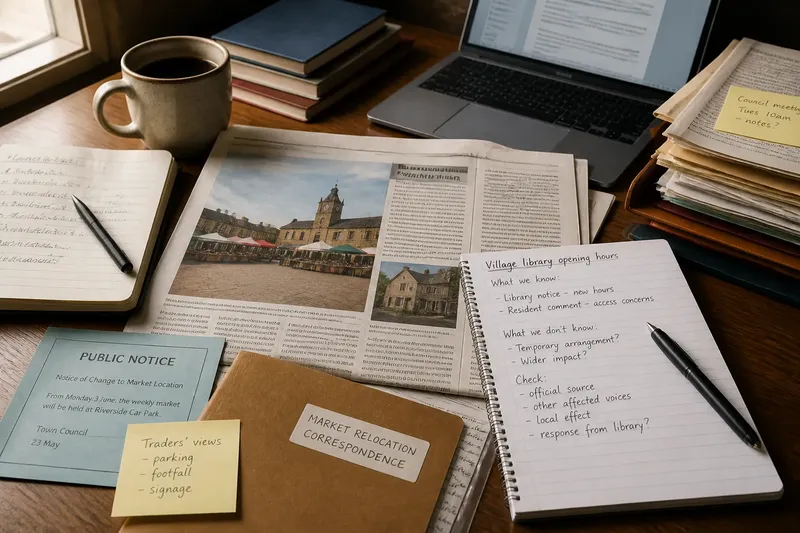
The news desk before the live feed had to decide which local report belonged on the page and what it needed before publication. That earlier newsroom structure offers a useful way to read regional news now: not as a trail of hidden decisions, but as a story shaped by selection, ordering and available evidence.
In eastern regions, a report about a council meeting, a village service or a local dispute may draw on documents, reporters’ observations and people’s accounts. Each source can illuminate a different part of the story. The newsroom’s task is to make those parts intelligible without implying that they all establish the same thing.
What does a desk make visible?
A news desk receives material in different forms: a reporter’s notes, a public notice, a community organisation’s message or a document. The published report rarely reproduces that material in full. Its opening, choice of voices and selection of background show what editors judged most useful to readers.
Those choices are worth noticing, but they do not reveal every discussion behind the story. A prominent opening may reflect the immediate effect on residents; a brief item may reflect the limited material available for a fuller account. The text itself is the soundest place to start.
Ask what the report puts first, what it explains later and what it leaves unresolved. That order can show whether the central point is clear before the detail begins.
How does a report connect different kinds of evidence?
Official records can establish what an organisation has stated or recorded. A person’s account can describe an experience, while a reporter’s observation can place an event in a particular setting. Strong reporting makes those roles legible through attribution and context rather than blending them into one voice.
Imagine a local paper reports that a market has moved from a town square. The article cites a council notice describing the new arrangement, while traders explain how they heard about it and what they expect to change. The notice supports the account of the council’s decision; the traders’ comments describe their concerns, not necessarily the decision’s full consequences.
When reading, look for the link between a claim and the material offered for it. If the article says a decision will affect a neighbourhood, does it explain who made that assessment and on what basis?
Why does placement matter to a local reader?
Where a report appears affects what readers encounter first. Editors may give prominence to a development with immediate local relevance, while another subject receives a shorter item or waits for further reporting. Placement is an editorial judgement, not proof that one issue matters more to every reader.
A missing story from a prominent page does not, by itself, explain why it is missing. The publication may have judged that the available material was too limited, or that another report needed attention first. Readers can assess the coverage more carefully by comparing the prominence given with the specific information in the report.
Notice whether the opening explains why the development matters to the place it names.
What should you check in a regional report?
- The location: If the report names a town, neighbourhood or service area, check whether the detail supports that scope; if it does not, treat the account as narrower than its headline may suggest.
- The central claim: If the article attributes the claim to a named person, organisation or record, follow that attribution; if the source is vague, regard the claim as less fully explained.
- The voices included: If the report explains why each speaker has relevant knowledge, read their comments in that context; if a directly affected group is absent, note that perspective as an open question rather than assuming its view.
- The evidence described: If the text identifies a notice, meeting or direct observation, consider what that material can establish; if it offers no supporting detail, keep the claim provisional in your own reading.
- The explanation of local effect: If the report connects the development to residents’ experience, check whose experience is described; if it gives only a general prediction, distinguish that forecast from an observed effect.
- The treatment of disagreement: If differing accounts are attributed and their basis explained, compare them without merging them; if one side has not responded, note whether the report says a response is pending or simply leaves the gap unexplained.
- The place in the coverage: If the prominence matches the stated local consequence, the placement is understandable on the page; if the reason is unclear, judge the article by its evidence rather than its position.
These checks help separate what the report establishes from what it raises for further attention. They are especially useful when a story concerns several communities but gives detailed evidence from only one.
What questions help you read editorial choices?
Why does this regional report lead the page?
Start with the opening and the people or places it names. If the report explains a concrete local consequence, its prominence has a visible basis; if not, the article may leave that editorial choice unexplained.
What can an official document establish?
A notice or record can show what an institution has published or decided, within the limits of that document. It does not automatically establish how residents experienced the change or what will happen next.
Why might a resident’s account matter?
A resident can describe an experience tied to a place or service. Read that account as evidence of the speaker’s experience, and look for further reporting before treating it as a description of everyone affected.
What does a short report leave out?
A brief item may provide the central development without explaining its history or wider effects. If it identifies what remains unclear, readers can see the boundary of the account; if it does not, the missing context remains harder to assess.
How can you compare coverage of one local story?
Take a concrete note of the article’s subject, the people or records it cites, and the question it leaves open. Imagine you read a report about a village library changing its opening arrangements: the article cites a library notice, quotes a nearby resident concerned about access, and does not explain whether the arrangement is temporary. Your note would record the notice as the stated source, the resident’s concern as an individual account, and the duration as unanswered.
If another report appears, compare its material with that note. A council statement about the arrangement’s duration would address the open question; another account of the same concern would add a voice but would not settle the timing.
The news desk before the live feed remains a useful lens on regional news because it directs attention to how a report is assembled for readers. When you return to a local story, compare its claims with its named sources and keep one unresolved question in view; that makes it easier to recognise what a later account actually adds.