A Reader’s Map for Following One Regional Story
A reader’s map for following a regional story helps you trace who shapes the account, how local reporting travels, and what changes as coverage spreads.
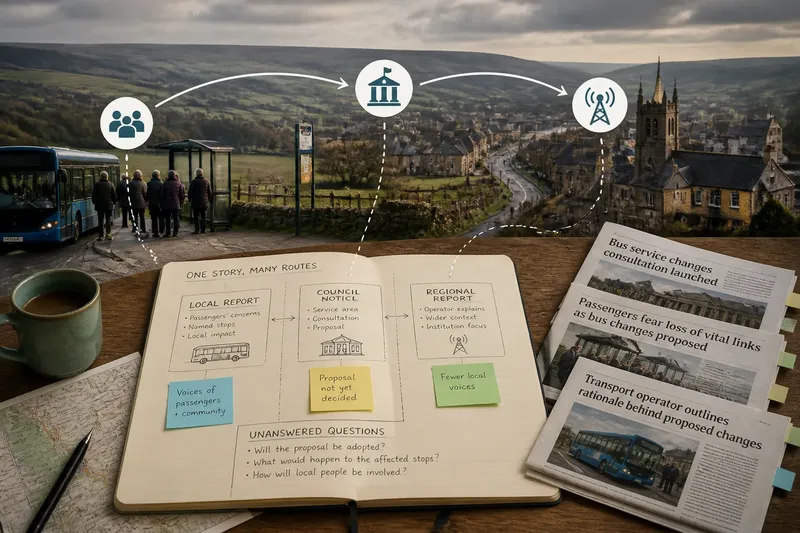
A reader’s map for following a regional story can reveal how a local account travels between places and institutions. A report about a market closure, for instance, may begin with traders’ concerns, then acquire a council, landlord or regional-development angle as other outlets take it up.
Rather than treating every article as another entry in a simple timeline, map the route the story takes: which people and institutions appear, which places become visible, and which parts of the issue remain outside the frame. That makes the map useful for understanding the shape of coverage, not just its sequence.
What should a reader’s map show?
Use a notebook, a spreadsheet or a plain-text document. Give each report its own entry, with enough detail to find it again and compare its focus with other coverage.
- Report and outlet: note the headline, publication and link, then decide if you can return to the source account.
- Place in focus: record the town, neighbourhood or institution named most prominently; if the location is vague, mark it as unspecified rather than guessing.
- People heard: note the roles or groups quoted; if only official voices appear, mark the account as institution-led and look for reporting that includes affected residents.
- Evidence used: identify whether the report refers to a document, interview, observation or another publication; if the basis is unclear, leave it unclassified and avoid treating its claim as independently supported.
- Geographic reach: record whether the report stays local or connects the issue to a wider area; if it makes a regional claim without explaining the link, note the missing connection.
- What the report adds: write one distinct detail or context point; if it adds none, mark it as a retelling rather than a new development.
- What is absent: name a relevant perspective or place not covered; if its absence matters to the issue, keep it as a question for later coverage, not as proof of deliberate omission.
Keep what you observe separate from what you infer. “The article quotes the council and two shop owners” is an observation; “the council’s account dominates” is an interpretation that becomes stronger when you compare it with other reports.
How does a local story change as it travels?
Follow the story’s route from its immediate setting to any wider regional frame. A local report may focus on how a change affects one street, while a regional outlet connects it to transport links, public services or decisions made beyond that town.
That wider frame can help explain why a local event matters, but it can also shift attention away from the people closest to it. Note what becomes clearer as coverage expands and what drops out: a regional account might explain the policy background while giving less space to residents’ practical concerns.
Say you are tracking reports about the closure of a rural clinic. The first account names patients and staff; a later regional piece explains the health-board plan but does not revisit those local effects. Your map would show the change in scope and the loss of on-the-ground voices, without assuming the later article intended to dismiss them.
How can I compare coverage without flattening the differences?
Compare the choices each report makes, not just whether its account agrees with another. Look at the headline, opening paragraphs, source selection and geographical frame; these show what the outlet treats as central.
For a specific claim, trace its stated origin. Several outlets may repeat a council statement, while another may refer to meeting minutes or speak directly with people affected. Record those distinctions so that repeated coverage does not look like a variety of independent perspectives.
Differences in emphasis are not necessarily contradictions. One article can describe a decision-making process while another examines its consequences for a particular neighbourhood. Note what each report addresses before deciding that their accounts conflict.
What questions help me read the map?
Who gets to define the problem?
Check whose words appear in the headline and opening, then compare them with the people quoted or otherwise represented. If an institution defines the issue but affected people are absent, mark that imbalance and seek reporting that includes their accounts.
Does regional coverage add useful context?
Look for a clear connection between the local event and the wider policy, place or institution mentioned. If the link is explained, note how it changes the local picture; if not, record the connection as asserted but unclear.
Are several reports relying on the same source?
Compare the cited statements, documents and interviews rather than counting outlets. If reports lead back to one announcement, label that shared origin; if a report brings distinct evidence, record what it contributes.
What does the map still leave uncertain?
Write unresolved points as questions tied to a place, group or process. If no report answers one, leave it open rather than turning the gap into a claim about what happened.
How can I work through a coverage map?
Imagine you are following reports about a proposed change to a county bus service. Your starting material is a local newspaper article quoting passengers, a council notice describing the proposal and a regional broadcaster’s report citing the transport operator.
- Enter each item separately with its outlet, link and publication date. The result is a record of three distinct accounts, not a single merged version.
- For the newspaper report, note the passengers’ concerns and the stops they name. The decision is to classify it as local-impact coverage, while leaving the proposal’s formal status open.
- For the council notice, record the service area and the stated consultation process. If it describes a proposal rather than an approved change, mark it as a proposal and do not write that the service has already changed.
- For the broadcaster’s report, note the operator’s explanation and compare it with the notice. If both refer to the same plan, record a shared subject; if the broadcaster adds a distinct explanation, mark that as its contribution.
- Compare whose perspectives appear across the three items. If passengers appear only in the local article, note that the regional account is more institution-focused and look for further local reporting before judging the wider coverage complete.
- Write down the unanswered question: whether the proposal will be adopted and what would happen to the named stops. If a later report or official record addresses it, add that source and update the map; otherwise, leave the answer open.
The map now shows different kinds of coverage—passenger impact, council process and operator explanation—without claiming that the proposal has become a final decision. It also makes clear which local details could disappear when the story is retold at regional scale.
When is the map useful, and when can I stop?
Update the map when coverage changes its geographic reach, brings in a new kind of source or shifts the question being asked. A new headline that repeats the same account need not become a new entry; add it only if its framing or evidence contributes something distinct.
Keep links rather than copying whole articles, and mark analysis or opinion as such. When later coverage no longer changes the story’s scope or answers a question you care about, you can stop adding entries while leaving the unresolved points visible.
A reader’s map for following a regional story is most useful when it shows not only what was reported, but whose account travelled and whose did not. That distinction can help you read the next local headline with a sharper sense of the places and people it brings into view.